
What I Learned From Interviewing Syrian Refugees In Jordan
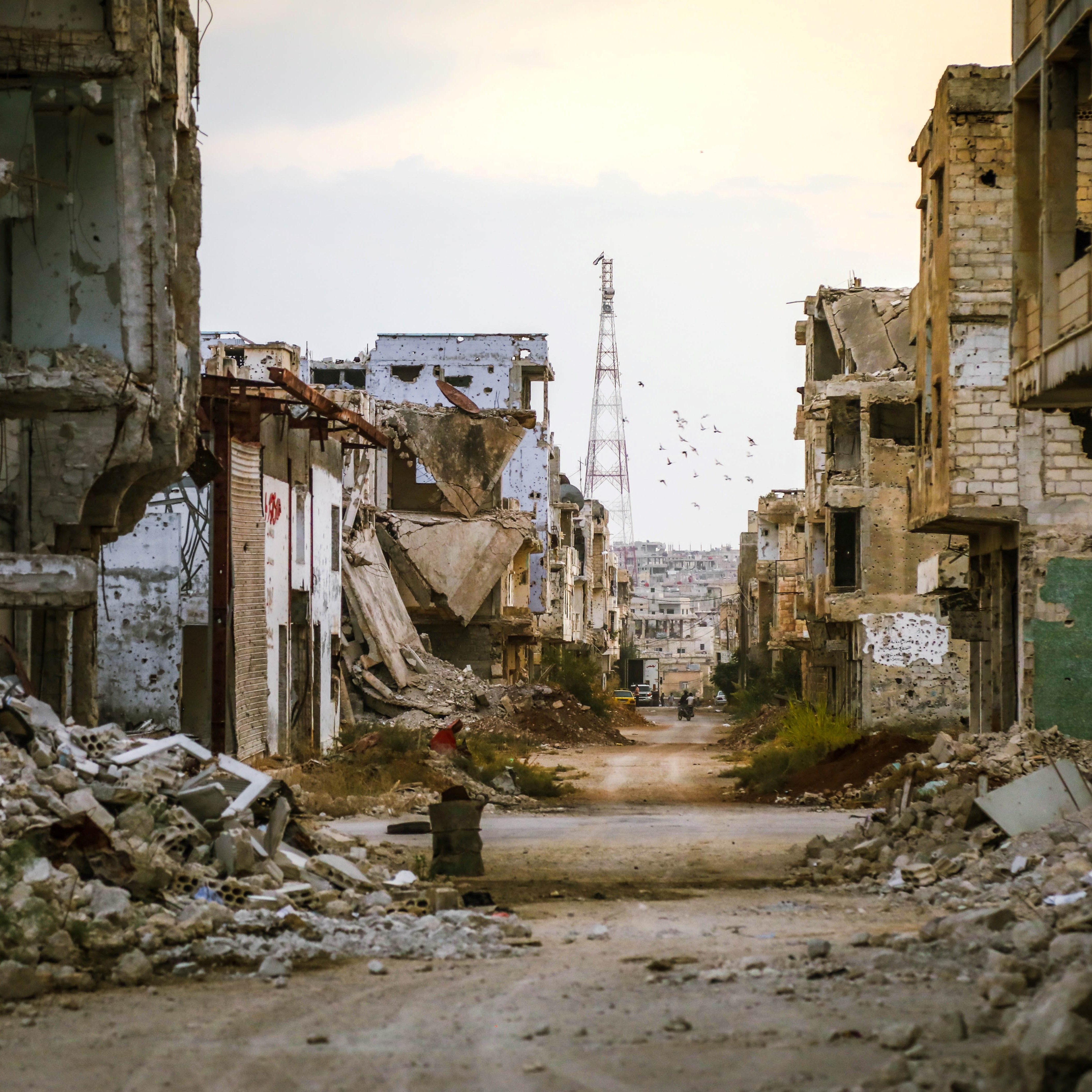
CONTENT WARNING: This piece contains graphic language describing Syrian war killings. Feel free to opt out and read last week’s post or my most read post instead!
July 2019-Northern Jordan
The woman, in black niqab with only her eyes showing, handed off her newborn baby girl – just 13 days old – to her older daughter, perhaps age three. The three-year-old daughter did her best to sit still, cross-legged next to her mom, and hold her younger sister in the right way, supporting the neck and head.
They looked so cute, the two of them together in a tiny little heap of arms and legs. The older sister was trying so hard to hold the baby properly. She approached her task with a grave sense of responsibility.
The mother – we’ll call her Ayla – sat next to them, vigilant and watchful, but not micro-managing. She was encouraging her daughter to practice holding the little one.
This was yesterday, outside Mafraq, Jordan. An hour north of Amman, in a tiny village in a tiny house, I spent part of my afternoon interviewing a Syrian refugee family from Homs, Syria.
We sat on the living room floor on thin mats and sweltered through the interview: my colleagues, Faisal and Abdullah, me, and this family of six.
Six months after I finally quit my job at RWG, I took a new job in Jordan with ACI Research, an international company that mainly does research studies funded by UN agencies, governments or nonprofits.
For the UN-funded research study I’m now working on for ACI, we are gathering data on Syrian refugees’ future plans and whether they plan on staying where they are (Jordan, Lebanon, Turkey, for example), going back to Syria, or – a long shot – attempting to travel some other place, like the US or Canada or Australia.
Syrian refugees have to constantly decide between multiple bad options. Life in Syria is difficult; life as a refugee is also difficult.
Which to choose?
How to choose?
Their decision-making processes, I’m learning from my interviews, are difficult and exhausting. There is a complex, ever-shifting equation going on in their heads: where can we be safe? Where can we find work? Where can we put the kids in school and keep them in?
Will the government of Jordan force us to leave, even if we want to stay here? If we go back to Syria will we be safe, with the war still going on?
Do we have a house here? (Can we afford the rent?) Is our house back in Syria still standing?
Faisal is UN staff and Abdullah works with me at ACI; together the three of us have been driving all over central and northern Jordan to interview refugee families who have agreed to participate in this study.
Almost all the families we’ve spoken to have been open, hospitable and patient in answering our questions. After we introduce ourselves and the study, we start asking about their thinking. Their calculations. Their decision-making tight rope.
This is how we found ourselves yesterday afternoon interviewing this man and woman from Homs and their four really cute, tiny kids. The littlest daughter half slept and dozed while we chatted with them. At some points her eyes were half open, half closed, and her lips were puckered up. Her skin was so soft and pink.

The two older brothers (maybe four and five?) alternated between sitting with us and, when they lost interest in the proceedings, charging around the house and chasing each other.
After the mother took the baby back from her older daughter and laid her gently down on the floor, Faisal kept saying, “Careful, there.” He seemed afraid the parents were going to somehow squash the baby, who was staring in a daze at the ceiling while they answered our questions.
I felt annoyed with Faisal for intervening in this way. They got it, I wanted to tell him. They’ve come this far.
It was another iteration of the message that the UN has been sending to refugees since the beginning of the UN: “You don’t know what you’re doing. Let me give you some advice. Let me help you with that,” when the thing in question is something refugees are perfectly capable of doing: taking care of their own children.
I noticed a lot of the families we interviewed this week were willing to discuss the rapes, arrests, murders, and disappearances happening in Syria right now – where violence reigns after 10 years of war – in front of their tiny children. This shocked me. In all my interviews, I kept wondering why.
Did they think their children were not listening or paying attention, as they sat nearby and watched TV, occasionally stealing glances at us, the official-looking visitors, with our badges and notebooks and recorder?
Did they think their children were listening in, but didn’t know these words – “rape” (ightisab in Arabic), “arrest” (a’atiqal), “murder” (qatal) – so it was safe to discuss in front of them?
Or, did they feel that their kids were listening and understanding, but that it was important for them, even at such a young age, to understand what was going on in their home country? They didn’t want to baby them, perhaps?
Or perhaps the children of Syria have seen so much by now, more than I can imagine, that the parents, weary, resigned, no longer bother trying to shield them?
Or, maybe they did want to shield their children from hearing about these horrific and gruesome things – Iranian militias wreaking havoc, slitting people’s throats, cutting out their stomachs and sprinkling salt into the gaping holes in their bodies – but that it was more important for them to share these things with us.
Maybe they felt these things had to be shared, to be known, to be heard. To be written down in my notebook and typed up in my final report.
Maybe they had a lot of faith in our research study (more than I myself do); they thought it might change something, politically. It might guarantee they can stay in Jordan.
So perhaps they thought to themselves, “I don’t want my children to hear and worry about this,” and they instinctively lowered their voices when they said the word rape, “but I can’t afford to leave it out. Sharing this could change the outcome for us.”
Meanwhile, I feel a bit useless, because I don’t believe our research study will help these people – this family, specifically – in the end. If the government of Jordan decides to kick them out, no report we’ve submitted to the UN will be able to change that.
All names are fake names, including ACI Research.
Read Part 2 here:
Do Refugees Benefit from Participating In UN Research Studies? (Part 2)


 Curious Georgie
Leave a comment