
And why we forget
Content warning: Heads up! I’m writing about the Israel-Hamas war, the Syrian war, and ISIS. It probably won’t be any more gruesome than just reading the daily news, with the way things are going, but I wanted to let you know up front. If you’d like to read something lighter, then hop over here instead!
The initial shock
It’s always shocking when a new war breaks out. As of last week, all-out war between Israel and Hamas has apparently begun.
I remember very clearly when the news kept reporting in February 2022 that Russia was on the brink of invading Ukraine. These reports seemed to go on for weeks:
In Ukraine Crisis, Putin Faces a Stark Choice.
With Buildup on Land and Sea, Russia Closes in on Ukraine.
Biden Warns U.S. Won’t Send Troops to Rescue Americans in Ukraine.1
With all this buildup, I wondered if it would actually happen. Then one day, it happened.
Those first 48 hours we are all glued to our screens, aghast. Pundits popped up overnight. TikTok videos abounded, and Instagram posts about Ukraine were reposted thousands of times. Those first few weeks, months, we couldn’t tear our eyes away from the carnage.
Here we are again, this week, watching the horrifying carnage unfold in Israel and Gaza after the horrifying attack by Hamas.
But wars always become forgotten wars.
Even the ones that start off sexy.
Would you like to be on my email list? Not all my posts are this depressing.
I don’t think Israel’s war with Hamas is starting off sexy, because the Middle East is already put into a certain bucket in many people’s minds. We in the West already associate this region, unfortunately, with conflict and terrorism.
But I do think Ukraine started off sexy. Sadly, it shocked us (again, in the West) to see a war in the backyard of white people, in a way we weren’t shocked by wars in other regions.
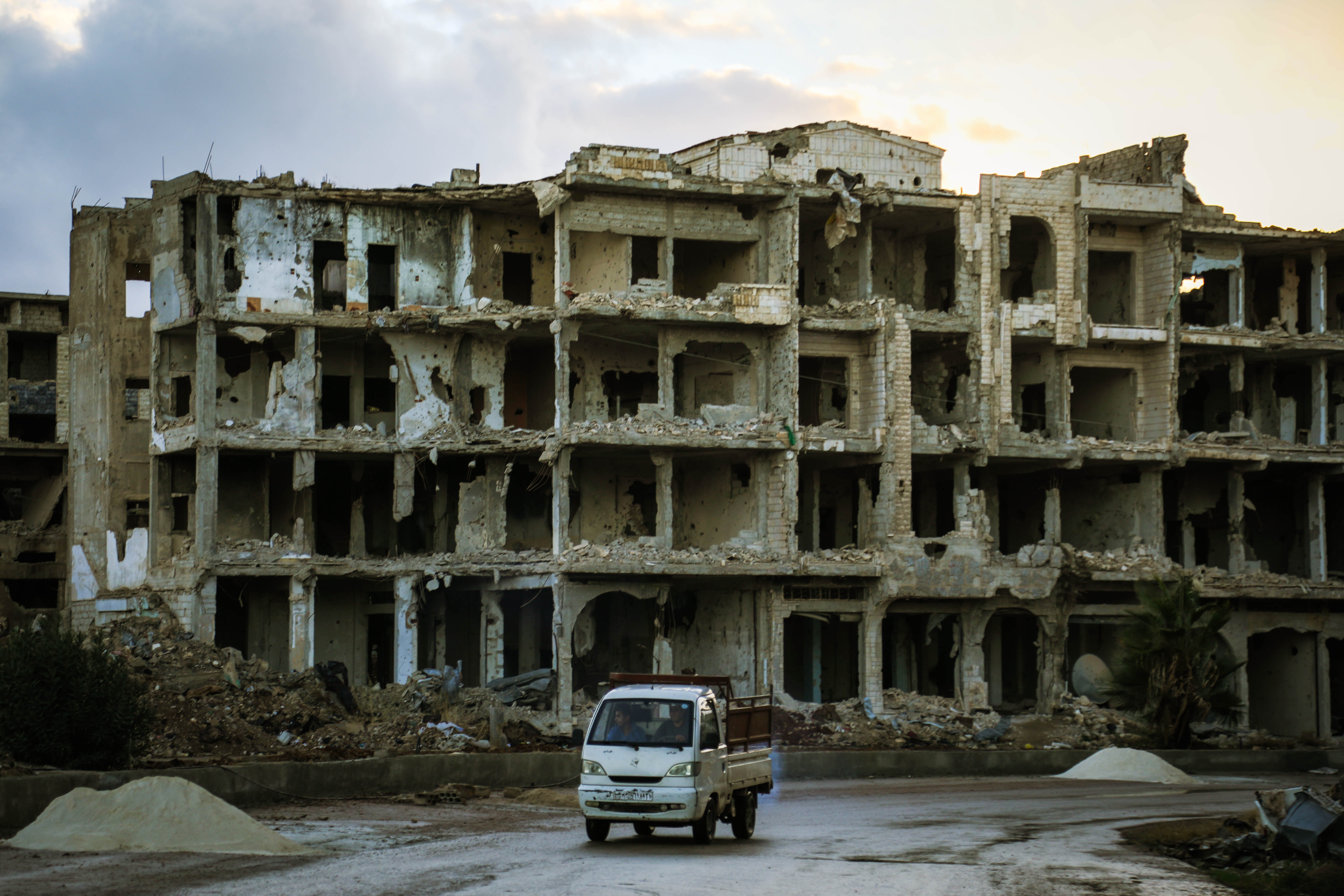
I have never been through a war. But I lived and worked for several years in the close orbit of a forgotten war – Syria – and I can’t stop thinking about what will happen when these newer wars, too, are forgotten, and local communities are left to pick up the pieces.
The Syrian war has been going on since 2011, when protests broke out against the Assad regime and the regime cracked down hard. That initial violence spiraled into 12 years (and counting) of war, bringing ruin to much of the country and paving the way for ISIS to spring up in a power vacuum along the way.
I’d say the world had Syria on its radar for roughly the first five to six years of the war.
Four years into that war, I graduated from college and moved to Jordan to take a job with a local nonprofit that was supporting Syrian refugees in Jordan. I helped run a youth center in a Syrian refugee camp for about three years, and I got to know some of the Syrians I worked with really well.
It was a strange and painful experience to dive so deeply into the Syrians’ experience, just through talking with them every day and hearing what was on their minds. Especially since I wasn’t Syrian and didn’t have firsthand experience with what they had gone through.
I felt rather ill equipped to do my job. Should I even be here? I would think to myself.
But I was also horrified and fascinated – in a grotesque way – by what I was learning from them about the war. I wrote about that time, “The war was the fire, and I stood up close staring into it. It burned me and fascinated me all at once, and I couldn’t tear my gaze away.”
If it weren’t for ISIS, the Syrian war would probably have been forgotten by the time I arrived to Jordan in 2015. But ISIS shocked us all in 2014, and so Syria stayed on the world’s radar until perhaps 2016 or 2017, when it was largely forgotten. It was from 2015 to 2018 that I worked in the camp, and I saw the (major, international) news coverage on Syria swell and then abate during this time.
After quitting my job in the camp, I took another job in Jordan in 2019, when Syria was largely off of our collective radar. For a UN-funded research project, I interviewed refugees all over Jordan about whether they intended to return to Syria or stay in Jordan. (The data could be summed up very briefly: no one felt Syria was safe to return to. They were staying put.)
After quitting that job, I took a third job in Jordan, remotely managing a research project in the northeast region of Syria. My company employed local Syrian data collectors in the northeast to go door to door and survey people about how they were coping with the ongoing war. The survey data was sent to us in Amman, where we analyzed it and wrote up reports for the US government, which funded the project.
The stories we heard were devastating. I held this job from 2020 until 2022, when Syria was well and truly forgotten.
And it’s these stories that jump into my head when I watch the Israel-Hamas war unfold in its first week.
Or when I click on a Ukraine article to see what’s happening there—all from my safe perch in Boston, MA, where the idea of a war happening seems laughably implausible.
There were mighty, earth shattering battles in Syria in 2012, 2013, 2014.
The specter of war reared its ugly head and ravaged the country, displacing millions inside and outside its borders. Then it retreated, and what it left in its place was famine and a destroyed economy.
There were not enough wheat stores in the region to feed everyone, so people were (and still are) going hungry. Some parents were skipping meals so their children could eat three meals a day. There were no jobs. This is what people told our data collectors who came knocking on their doors. This is what I dutifully translated from Arabic to English and wrote up in my reports.
ISIS still lived on, but in a much less Hollywood thriller way. Having dropped off the front pages as new crises came up, it quietly entered an even more terrifying phase: sleeper cells of hardened fighters that were seemingly never going to go away. Still today, these sleeper cells are all around northern and central Syria, which terrifies me when I think about it.
The Syrian war still lived on, but also in a less Hollywood thriller way. It, too, quietly entered an even more terrifying phase: the collective despair of a nation of people who slowly lost hope that things would get better.
This is what I keep thinking of when I read the news out of Israel and Gaza this week.
Of course, Israel and Palestine have been locked perpetually in conflict for decades. It’s not as though there was a fresh slate of peace upon which war broke out.
And yet what we saw this week was the horrifying shock of war. It was the car accident phenomenon, where it is gruesome, and yet we cannot look away. The news apps on our phones send us updates every 12 to 18 minutes.
This just in.
This just in.
This just in.
Refresh.
Refresh.
Refresh.
All I can think about is how, tragically, this war, too, will be forgotten. As will Ukraine, eventually. And what is left is an exhausted group of people, the Ukrainians / Syrians / Gazans / Israelis, who have no choice but to keep going, day after day.
What makes us forget wars?
We forget, I guess, partly due to news fatigue and war fatigue. The average human can only handle such push notifications every 12 to 18 minutes for… a few weeks? A week? After that, naturally, we need to update our push notification settings.
Then the updates, after six or so months, gradually drop down to the middle sections of the papers.
It’s depressing, but more tragedies will happen. They will grab the top spots, as will Trump’s trials, the 2024 election, and whatever China does next.
Forgetting happens, also, because we (in the West) don’t feel that we are like ‘these people’.
Forgetting happens, also, because we are human and humans have historically been forgetting things for all of time and that is why history keeps repeating itself.
I wish that we could identify more with Gazans. With Arabs in general. That this conflict was not so asymmetrical. That Israel (and the US) hadn’t ignored most of the demands of the Palestinians these past fifty years. I wish that we could remember these things. Remember what happened before, instead of thinking Hamas militants came out of nowhere on Saturday to perpetrate this horrible attack. I wish we could remember not so we could excuse the Hamas attack, but so we could look more unflinchingly at the whole picture of what is happening here.
In the early days of the Ukraine war, western news anchors, podcasters, and pundits everywhere were fired up. We need to repel Russia. This is unconscionable. I agreed that it was unconscionable. Yet all I could think when hearing all this fired up-ness at the time was: this war is sexy now but someday it’s going to be like Syria.
This war is sexy now but someday it’s going to be like Iraq.
I automatically start thinking about the time when the camera men and women have all gone home.
I think about a time when Congress will have moved on to new conflicts, new House speaker fights, new foreign aid packages to approve and squabble over. I imagine a time when Israel and Gaza have dropped out of the news now that this has dragged on for the better part of a decade, ever since Hamas’ shocking attack on Israel years ago, in October 2023.
In that future time, most of the foreign interest has waned, and those who are left picking up the pieces, obviously, are the Israelis and the Gazans. They are the ones who are there futzing with generators and trying to repair them so they can have electricity for the night since the main power grid is still down in their town.
They are the ones who are baking bread with corn meal instead of flour, since there isn’t any. They are the ones who are gathering kids together in someone’s home for a makeshift lesson, since the school hasn’t been rebuilt yet and there’s no funding for it.
When the streets are craters and famine is setting in, but the heady and shocking days of the war are long over—that’s when the foreigners aren’t around anymore and the foreign assistance has dwindled to a small trickle. But the locals are there. They always have been and they always will be, war or no war, global attention or no global attention.
The moms, dads, grandpas, grandmas, kids–they have no choice but to futz with the generators and bake the bread and go one more time to the market to see what can be bought for dinner. And visit the graves of loved ones who were killed.
What else can be done?
Nothing to do but keep going, keep piecing things together, keep putting food on the table for their kids.
It’s them I think of when war breaks out, even when it’s in those early, shocking days. Because wars, tragically, always become forgotten wars. In my mind, I just jump ahead a few years and think of the ones who will be left.
- All New York Times headlines from February 2022. ↩︎


 Curious Georgie
Leave a comment